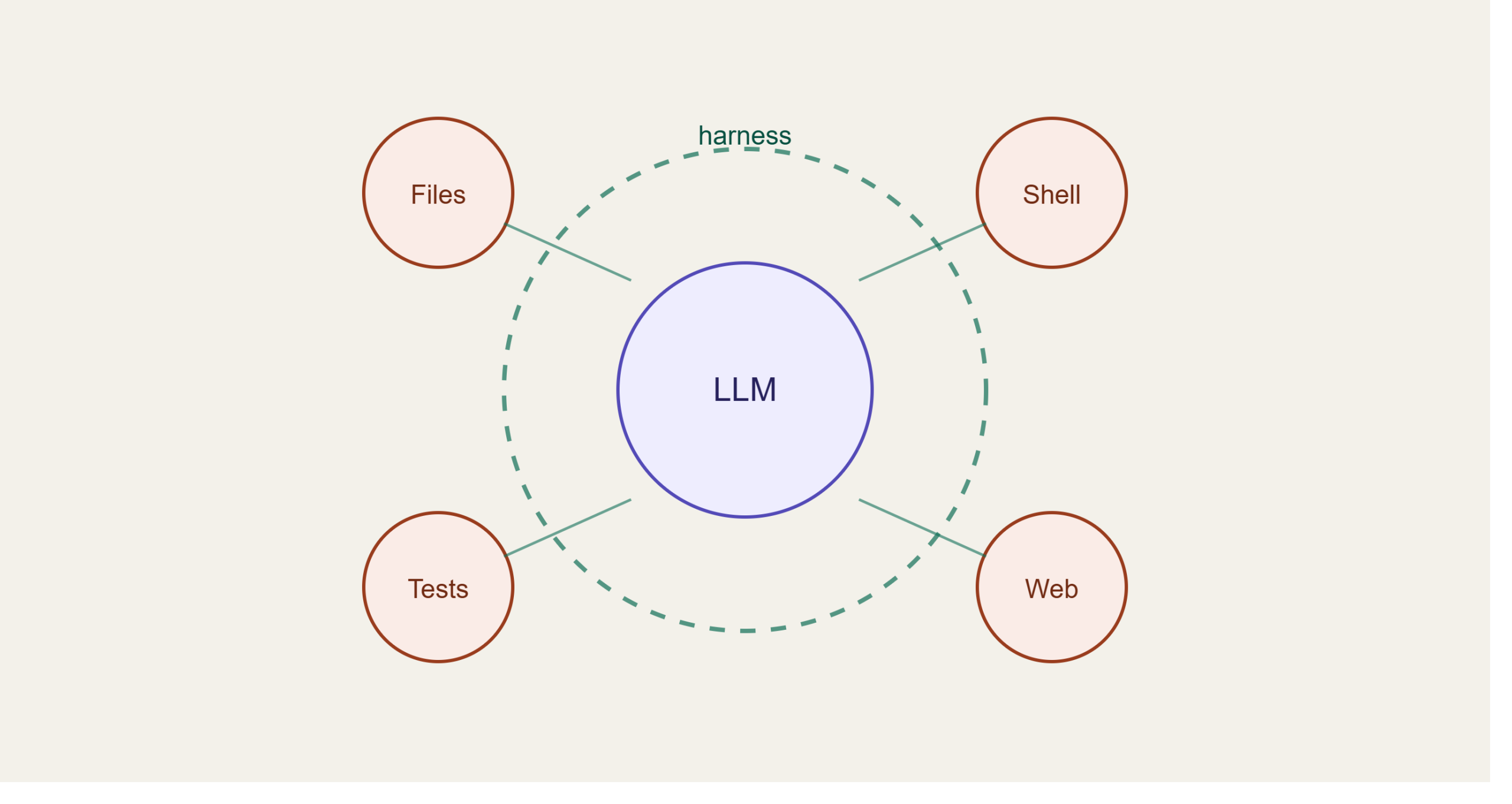
Most developers have now encountered tools like Claude Code or OpenAI’s Codex CLI — but fewer have stopped to think about what’s actually happening beneath the surface. These aren’t just LLMs with a prettier interface. They represent a specific architectural pattern: wrapping a language model inside an application layer designed to make it act, reason, and iterate — not just respond.
The Core Idea: A Layer Between the Model and the World
An agentic harness is the scaffolding that transforms a raw language model into something capable of completing multi-step tasks autonomously. The LLM itself — whether it’s Claude 3.5 Sonnet or GPT-4o — doesn’t inherently know how to browse a filesystem, run tests, or loop back on its own errors. The harness provides that infrastructure.
Concretely, a harness typically includes:
- Tool definitions — structured interfaces that let the model call functions like
read_file,run_shell_command, orsearch_codebase - A planning loop — logic that feeds model output back as input, allowing for iterative reasoning across multiple steps
- Context management — mechanisms to track conversation history, inject relevant files, and stay within token limits without losing coherence
- Error handling and retry logic — so that a failed command doesn’t halt the entire task
Without these components, the LLM is a very capable text predictor. With them, it becomes an agent that can work toward a goal across time and state.
Why “Harness” Is the Right Word
The term is borrowed from software testing, where a test harness is the surrounding infrastructure that lets you execute and evaluate code in a controlled environment. The analogy holds. An agentic harness doesn’t change what the model knows — it changes what the model can do, by giving it access to external systems and a structured execution loop.
This framing also clarifies why two tools built on the same underlying model can behave so differently. Claude Code and a basic Claude API integration both use the same model weights. The harness is the differentiator — it determines the model’s effective capability ceiling for real-world tasks.
Advertisement
What Claude Code and Codex CLI Actually Do Differently
Both Claude Code and Codex CLI are purpose-built agentic harnesses optimized for coding workflows. They handle the implementation details most developers don’t want to wire up manually:
- Automatically reading and writing files in the working directory
- Running terminal commands and parsing their output
- Maintaining task context across many model calls
- Asking clarifying questions when requirements are ambiguous
The result is a tool that can take a vague instruction like “refactor this module to use async/await” and execute it across multiple files, run the test suite, interpret failures, and iterate — without human intervention at each step.
Building Your Own vs. Using an Off-the-Shelf Harness
Frameworks like LangChain, AutoGen, and LlamaIndex let teams build custom agentic harnesses for domain-specific use cases. The tradeoff is real: off-the-shelf harnesses like Claude Code are optimized and battle-tested for their target use case, while custom harnesses offer full control over tool access, safety constraints, and task structure.
Advertisement
For most engineering teams, the practical question isn’t whether to use an agentic harness — it’s which one fits the workflow, and where the boundaries of autonomous action should be set.