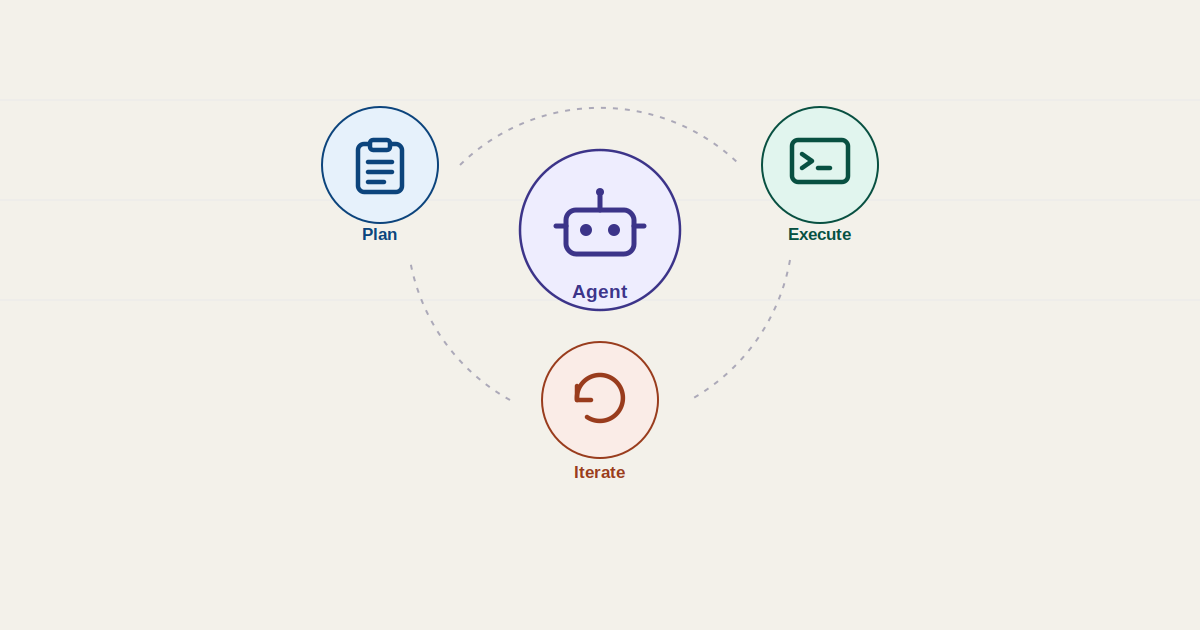
Software teams are no longer just adopting AI tools — they’re rearchitecting how the entire development process works around autonomous agents that plan, execute, and iterate with minimal human intervention. This shift is fundamental, not cosmetic.
What “Agentic” Actually Means in a Development Context
An agentic system doesn’t just respond to a single prompt — it pursues a goal across multiple steps, using tools, memory, and decision loops to complete complex tasks. In software engineering, that means an agent can receive a feature requirement, write code, run tests, interpret failures, and revise — all without a human in the loop for each step. The key properties are autonomy, tool use, and multi-step reasoning.
Where Agents Are Entering the SDLC
Agentic AI isn’t replacing the full cycle — it’s inserting itself at high-friction points where context-switching and manual effort slow teams down:
- Requirements analysis: Agents can parse product briefs, flag ambiguities, and draft acceptance criteria before a single line of code is written.
- Code generation and review: Beyond autocomplete, agents now propose full implementations, check them against a codebase’s existing patterns, and raise pull requests.
- Testing: Agents generate test suites, identify coverage gaps, and re-run targeted tests after a patch — reducing the manual QA burden significantly.
- Incident response: When a build breaks or a service degrades, an agent can triage logs, hypothesize root causes, and even draft a fix for engineer review.
The Engineering Discipline This Demands
Integrating agents into production workflows isn’t a plug-and-play exercise. It requires a new layer of engineering thinking:
- Prompt engineering and agent design: How tasks are framed, how tools are described, and how memory is managed directly determines agent reliability.
- Guardrails and observability: Autonomous agents need scope limits, output validation, and full audit trails — especially when they’re touching production systems or customer data.
- Human-in-the-loop checkpoints: The most effective patterns aren’t fully autonomous — they’re human-supervised autonomy, where agents handle execution and engineers handle judgment calls.
- Failure mode planning: Agents can confidently produce wrong outputs. Teams need explicit fallback logic and escalation paths baked into the workflow.
Agentic Patterns Worth Knowing
Several architectural patterns have emerged as the practical building blocks of agentic engineering:
ReAct (Reason + Act): The agent alternates between reasoning about a problem and taking an action, iterating until it reaches a solution.
Advertisement
Plan-and-execute: A planner agent breaks a goal into subtasks; executor agents handle each subtask independently.
Multi-agent collaboration: Specialized agents (e.g., a security reviewer, a documentation writer, a test generator) operate in parallel or sequence, each focused on a narrow role.
These patterns are now appearing in frameworks like LangGraph, AutoGen, and CrewAI — all designed to orchestrate agent behavior in structured, repeatable ways.
Advertisement
The Honest Trade-Offs
Agentic workflows increase throughput — but they also increase the blast radius of mistakes. An agent that misunderstands a requirement and generates 500 lines of code in the wrong direction wastes more time than a junior developer making the same error, because the output looks polished. Speed without accuracy is expensive. Teams that see the strongest results are those that invest in tight feedback loops, clear task scoping, and ongoing evaluation of agent outputs — not those who simply automate and trust.
What This Means for Engineering Teams Today
The engineers who will thrive in this environment aren’t necessarily the ones who write the most code — they’re the ones who can design reliable agent workflows, evaluate AI outputs critically, and know precisely where human judgment remains non-negotiable. Agentic engineering is a skill set, not just a toolset.