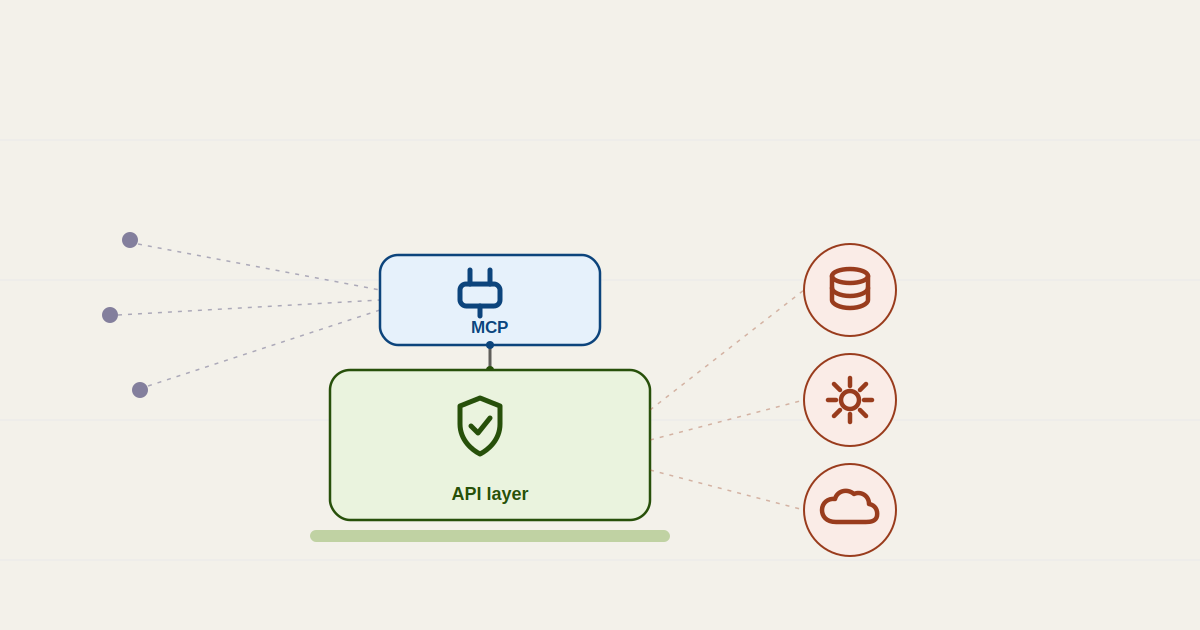
Model Context Protocol (MCP) has generated real excitement as a standardized way to connect AI agents to tools and data sources. But there’s a growing assumption that MCP alone is sufficient architecture — that you can expose functionality to an LLM and call it done. In practice, that assumption breaks quickly once you move beyond demos and into production systems.
What MCP Actually Does (and Doesn’t Do)
MCP defines how a model communicates with an external server — the shape of the conversation, the tool-calling interface, the protocol layer. What it does not define is what happens on the other side of that server. The MCP boundary is just the entry point. Everything behind it — authentication, data validation, rate limiting, error handling, business logic — still needs to be built, and built properly.
Think of MCP as a well-designed front door. A good front door matters, but it doesn’t replace the need for a structurally sound building behind it. If your MCP server is hitting raw database queries, undocumented internal scripts, or brittle one-off integrations, you’ve just given an AI agent a direct line to fragile infrastructure.
Why Skipping the API Layer Creates Real Risk
When developers wire MCP directly to backend logic without a proper API contract in between, several problems emerge fast:
- No schema enforcement: Without a well-defined API layer, inputs from the model may not be validated before they hit your data layer. LLMs can produce structurally valid but semantically incorrect calls.
- No rate limiting or throttling: An agent running in a loop, or triggered by an automated pipeline, can hammer your backend in ways a human user never would. A solid API layer handles this gracefully.
- Harder observability: APIs give you a natural logging and monitoring boundary. Without one, debugging agent behavior becomes a forensic exercise across multiple system layers.
- Tight coupling: Direct connections between MCP servers and internal systems mean any backend change can silently break agent behavior. An API contract creates a stable interface that can evolve independently.
The Cases Where a Robust API Is Non-Negotiable
Not every MCP use case carries the same risk profile, but several scenarios make a solid API layer essentially mandatory. As explored in this breakdown of MCP architecture considerations, the complexity of what sits behind the server matters enormously when you’re dealing with:
- Multi-tenant systems where data isolation is a hard requirement
- Financial, healthcare, or compliance-sensitive data where audit trails are non-optional
- High-concurrency agent workflows that can generate unpredictable load patterns
- Integrations with third-party platforms that enforce their own rate and access limits
In these contexts, trying to shortcut the API layer doesn’t save time — it moves risk forward into production where it’s far more expensive to fix.
Advertisement
MCP and APIs Aren’t in Conflict
The right mental model is that MCP and a well-designed API are complementary, not competing. MCP handles the how of agent-to-server communication. Your API handles the what — the authoritative interface to your system’s capabilities, with all the durability, documentation, and governance that implies.
Some simpler MCP servers — a local file reader, a personal productivity tool, a single-user search wrapper — may genuinely not need a formal API layer. The overhead wouldn’t be justified. But the moment you’re building something that will handle real users, sensitive data, or agent-driven automation at any scale, the API layer stops being optional and starts being the thing that makes your MCP server actually production-ready.
The protocol is only as reliable as the system it connects to. Getting MCP right means thinking carefully about both sides of that connection.
Advertisement