By Software Architecture & AI Engineering Team | Updated August 2026
In the rapid evolution of software engineering, we have moved past simple prompt completion. Generative AI is no longer just autocomplete for code; it has evolved into agentic automation driven by Loop Engineering. The core hypothesis driving this shift is ambitious: Can Loop Engineering eliminate developer intervention altogether through agentic automation?
As engineers who have built and deployed autonomous coding agents, we have witnessed both the breakthrough potential and the practical boundaries of agentic loops. Here is an evaluation of where loop engineering stands today, beyond the industry hype.
1. From Static Prompts to Autonomous Loops
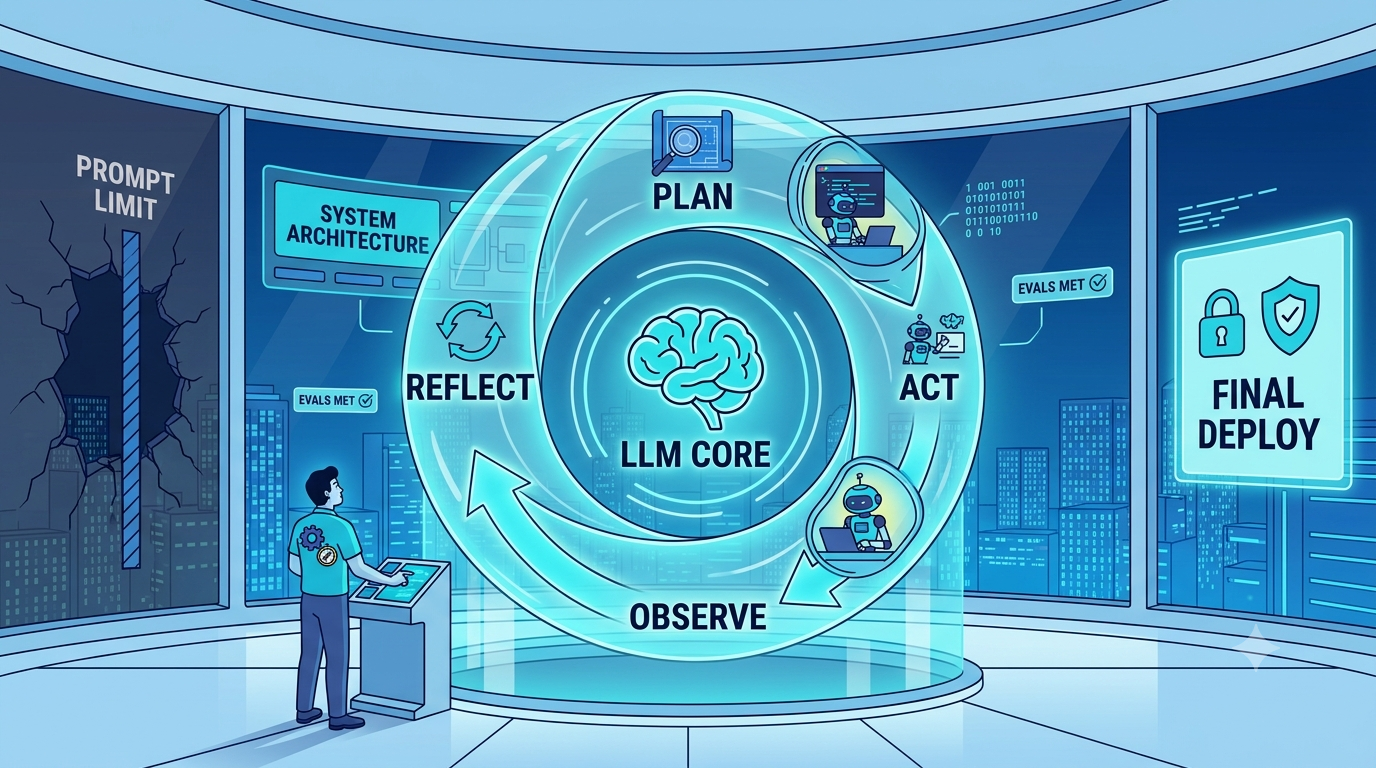
Traditional AI integration relies on single-turn prompt engineering—a input-output pipeline requiring constant human intervention. In contrast, Loop Engineering builds state-aware, iterative feedback systems that allow an AI agent to execute tasks autonomously through a structured workflow:
- Plan: Deconstruct a feature request into actionable steps.
- Act: Write code, create files, or trigger terminal commands.
- Observe: Parse compiler errors, test logs, or linter output.
- Reflect & Correct: Modify code based on runtime feedback and loop until success criteria are met.
By giving agents access to terminal tools, version control, and execution environments, the loop operates without requiring step-by-step human prompts.
2. The Operational Reality: Experience Beyond the Hype
While the theoretical promise of loop engineering is total developer elimination, production reality presents hard engineering challenges:
Advertisement
- Infinite Error Loops: Without strict deterministic termination rules, agents can get caught in circular debugging routines, consuming tokens without resolving root architectural causes.
- Context Window Degradation: As error traces and iterative retries stack up, the model’s effective context degrades, leading to hallucinated fixes.
- Architectural Oversight: Agents excel at localized bug fixes and micro-refactoring, but struggle with macro-level system architecture, cross-service contracts, and security boundary design.
Eliminating human intervention entirely in non-trivial codebases often leads to brittle technical debt unless rigorous automated evaluation frameworks (Evals) and sandboxed environments back every iteration.
3. The Verdict: Elimination vs. High-Level Control
Does loop engineering eliminate human developers? Not completely—it transforms their role.
Instead of writing boilerplates and manually debugging runtime syntax errors, developers shift from code executors to system orchestrators. Human intervention moves up the abstraction ladder: setting security bounds, defining test-driven evaluation criteria, and approving high-stakes deployment targets.
Advertisement
Loop engineering automates the mechanics of execution, but human expertise remains essential for intent, domain logic, and ultimate accountability.